Monday, August 5, 2013

Why did the Kansas Sampler Foundation spend so much time with Muscotah?


Several people have asked why we have spent so much time supporting and promoting Muscotah.  I have been remiss in explaining this part!

TO LEARN
Two towns were chosen to help us learn some things so we could create a successful program called Kanstarter (formerly known as the We Kan! Bank), that will be of benefit to all Kansas communities.

The plan is for Kanstarter to operate somewhat like Kickstarter, a crowdsourcing funding mechanism for the global creative arts world. Kanstarter will be used to connect community projects with those who want to help through volunteerism or donations.  The bottom line is to develop and support projects that will help sustain communities. 

FIRST HAND EXPERIENCE

In 2009, we chose to "practice" in Whiting (Jackson County, population 200) with a project commonly known as the Whiting Cafe Makeover.  Through a statewide and global network, we raised over $6,000 and had dozens of volunteers show up for a work weekend. 

Our next effort was to support Muscotah (Atchison County, population 200) with their dream of capitalizing on native son and major league baseball Hall of Famer, Joe Tinker, in creating a spark for the town.

STATISTIC:  Of the 626 incorporated cities in Kansas, more than half have less than a 400 population.  What are we, as a state, doing to support these volunteer-led towns?

WHY WHITING AND MUSCOTAH?
Every year the Kansas Sampler Foundation does a Retreat for Rural Leaders at the Barn Bed-and-Breakfast in Valley Falls. The retreat includes an annual field trip in order to have a first-hand experience with  the theme of the year.

Whiting and Muscotah are within close proximity to Valley Falls.

Jeff and C.J. Hanson of Muscotah came to Whiting to help with the Whiting Cafe project.  Jeff caught the "fever" and came up with a dream for his town.  This led to several Muscotah visits from our retreat attendees over the last four years.

INSPIRATION
The first year we visited Muscotah, we met in the city building.  We all sat in a circle.  The Muscotah folks went first to introduce themselves.  Without being prompted, each one said how many years they had lived in the town and why they loved it.  In the dead of a wet winter the town was looking dreary with its unpaved roads and abandoned business buildings.   By the time the last Muscotah person spoke, our hearts were warmed and we were ready to run through a brick wall for them.

We came back a year or two later to check on them and to see how their dream was progressing.  That's when the idea was hatched to convert the old round water tower tank into the World's Largest Baseball.  From there, the room was buzzing with ideas and promises -- and hope.


WE COMMITTED
Our group committed to being there for them, to use our individual and group networks and resources to help them be the best they could be at being Muscotah.  They would have to do the bulk of the work.  We would be like back-up singers to the main act.

THE NETWORK
Could the simple use of a network help raise the funds, produce volunteers and experts, find technical know how, promote events like the Work Weekend and Joe Tinker Day, and attend and celebrate with Muscotah in a manner that would make a difference?

Clearly, the answer is yes. 

Muscotah citizens did all the heavy lifting.  The "outside world" rallied around them.

WHO WON?
Muscotah was a winner because of the exposure and many tangible results for their community.

Those who took part as volunteers, technical resource experts, or financial contributors were winners because of the satisfaction they received being part of a group that literally helped boost a town forward.

Local and area businesses were winners, too, because supplies were purchased from them.

DID IT SEEM LIKE THIS WAS JUST ALL ABOUT MUSCOTAH?
It probably seemed like this was just a gift for Muscotah.  The truth is that they worked harder than any of us.  It's not easy to be in the trenches and be the last line of responsibility.  With a very strong core group, they took advantage of all the support and made it happen.
As the clearinghouse, the Kansas Sampler Foundation observed this "experiment" through the eyes of Muscotah, the volunteers, the donors, the media, and all of the parties involved.  With what we learned, we have a better chance of making Kanstarter a better product as we work with Reflective Group in developing this online mechanism of support for all Kansas communities.


A DOZEN THINGS WE'VE LEARNED OVER THE YEARS ABOUT COMMUNITY PROJECTS

1)  Buy in.  Community projects work best if everyone has had a chance to offer ideas, comments, or questions.

2)  All age groups.  Don't just count on the usual players.  Enlist input from all age groups.  Really listen.

3)  Communicate.  Keep everyone informed.  Find the best communication method whether it be a posted message or social media.

4)  Strong leadership.  Calm, focused, respected leaders are needed to take a town through the tough times.

5)  Do what is right.  The popular plan might not always be what is right.  Stick with what is right.

6)  Community foundation.  A trusted mechanism for receiving donations is a necessity.

7)  Network.  The most interested people in supporting your community are those who have graduated or once lived in your town.  Developing a list of these people and staying in touch is priceless.

8)  Set your ego aside.  This is not about you.  It's about community, it's about being a team.  Make it so.

9)  Make it worthwhile.   In this day of busy people and crowded calendars, each meeting and each event needs to be worthy of everyone's time.

10)  Help others, they'll help you.

11.  Coffee shop talk.  Be the supportive and positive voice.

12.  Celebrate.  Have fun with your community!


Each experience helps KSF "get" Kansas!  KE #2 Marci Penner

Thursday, August 1, 2013

Muscotah Wins on Joe Tinker Day


The Kansas House of Representatives declared July 27 as Joe Tinker Day in Muscotah.  It could have also been declared “One of the Best Days Ever” in Muscotah, a small town in western Atchison County.

Celebrating Muscotah native son, Joe Tinker, was the main objective but July 27 turned out to be much more.

First, some background.  Tinker was born on July 27, 1880 and died on the same date in 1948.  He achieved fame as part of the Hall of Fame double-play combination Tinker to Evers to Chance that helped the Chicago Cubs win the World Series in 1907 and 1908.

 
In the last couple of years, a group of committed Muscotah citizens has been working to put a spark back in Muscotah by creating Joe Tinker-themed attractions.  The old water tower tank has been converted into the World’s Largest Baseball with the intention of creating a community and rural baseball museum inside of it.  Beside the ball, a mini-infield and outfield fence is awaiting silhouettes of Tinker and Evers and Chance.  Memorial roses have been planted beneath the fence and Wrigley ivy will soon follow.  

On Joe Tinker Day, two vintage baseball teams, the Hodgeman Nine and Cowtown Vintage Base Ball Club using 1860s uniforms, rules, and equipment, entertained more than 500 people who lined the foul lines on lawn chairs, straw bales, blankets and the back of pick-up trucks.  Hawkers carrying trays of peanuts, popcorn, and CrackerJack strolled through the crowds.  Hotdogs, apple pie and ice cream were sold.  Leoti’s Simone Cahoj and a group of the vintage ball players led the crowd in “Take Me Out to the Ballgame” during the seventh-inning stretch.  Two goats were present to help reverse the 1945 Billy Goat curse on the Cubs.

The Chicago Cubs major league baseball team even got in the act by sending three bricks from the famed Wrigley Field brick outfield wall.  A bucket of infield dirt came with the bricks as well as a congratulatory letter from Tom Ricketts, the owner of the Cubs.

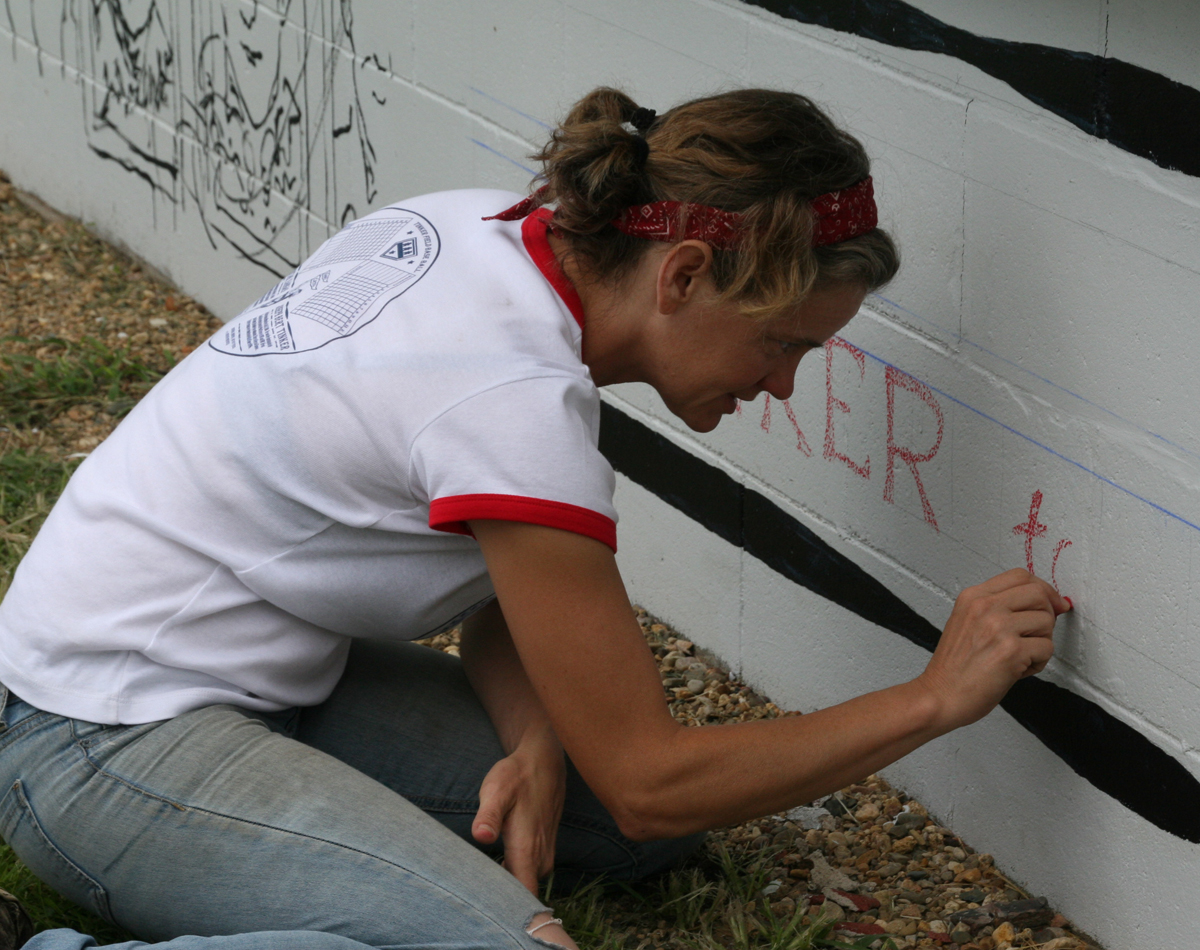
Artists Erika Nelson and Matthew Farley were on hand to talk about the historical baseball mural that they are painting on the concrete block concession stand.  
Relatives of Joe Tinker came from Baltimore and California to see their ancestor’s hometown and to witness  the effect  their ball-playing Joe has had on this small town of 200.  A standing-room only crowd enjoyed 75-minutes of stories and revelations in a Question and Answer session with the two grandsons (who had never met) and the two great-grandsons.  Afterwards, interviews and autographs were in high demand from these celebrities-for-a-day.
Many from around the state attended who had donated or volunteered time to help with the Tinker projects.   Mixed in the crowd that included locals, baseball fans, historians, and small town supporters, this special group watched quietly with pride in their contribution.

Nobody will remember who won the ballgame, nor does it matter.  What will stick in the minds of those who attended is the determination of this town to help itself as well as the quintessential Americana experience we all had on this day.  Words of praise for Muscotah from the Tinker family will long ring in our ears. 
photo by Tom Parker
Muscotah is the “little town that could” and long after the last run crossed the plate, those who live in Muscotah will continue to work hard with little fanfare for the town they love. 

Perhaps the moral of the story is that we're a better state, a better society when small towns thrive.  They need our cheers and participation in the game.  When we all come together, we all win.


The Muscotah Experience is a great one to relate to help people "Get Kansas."  KE #2 Marci Penner

Monday, June 10, 2013

Strataca!


What did the Kansas Underground Salt Museum do?  They Stratacized!

To Stratacize means to be bold and daring.  No, you won't find "stratacize" in the dictionary but it should be.  With an intrepid manner, the board and staff just up and changed their name.

They (board, staff and marketing company) didn't think that the name "Kansas Underground Salt Museum" was doing justice to the amazing experience one can have down under.  There really was nothing wrong with the original name.  The museum is underground (amazing).  It is about salt (a story rarely told).  It is in Kansas.  Still, there was that little word at the end, "museum."  That's what prompted the change.

Times have changed.  Museums once saved the day by collecting artifacts and telling their story.  Some places do it beautifully and much can be seen and learned.  Unfortunately, not all museums have the budget or resources to bring the best out of a collection of artifacts.  Rather than fight the stereotype, this place that is as much an adventure as a place to see and learn, took action.  They "stratacized."

First, you don a hard helmet and get in a dark elevator and plunge 650 feet down.  For over two minutes you go down.  Where else can you do that?

You come out of the elevator and you are surrounded by solid salt walls!  Even the walls and ceiling are the real thing.


After walking by exhibits, you come to a tram area.  This is where you can jump aboard and take a "dark ride" to see and learn.  It's called the dark ride because at times you are moving along in complete darkness. That was what miners experienced at times.  And, yes, before you, miners were down there in the exact same area dynamiting the salt and sending it to the surface.  You are seeing the result of this, right there in a mine!

You can also ride a train.  It's actually feels more like riding along on old-fashioned school desk seats pulled by a miniature locomotive.  You're on actual track used by the miners.  It's just hard to fathom that you are in a mine and that somewhere further down the line, actual mining is still going on at the same level.


You see things left by the miners.  Even vehicles were let down into the mine by a hoist but nothing was ever really taken back up -- except the salt.


There is no doubt that the salt museum is a tremendous venue to visit.  In every way, it deserves its status as one of the 8 Wonders of Kansas.  Come on, it's the only underground salt museum in the western hemisphere!

But let's get back to the name.

Strataca.

What a fearless move.

Not everyone will like this.  It's audacious, it's gutsy -- and it's the right thing to have done.  This incredible experience deserves an all-out effort to attract an audience that wants adventure, wants to learn, wants to be treated to something they won't forget.  The name carries expectations with it and the ground down under does not disappoint.

With the new name, the staff is energized and feeling more playful and fun.  The name removes boundaries of making this attraction one of the best there is.

A place in Kansas did this.  Dull and boring?  Not at Strataca.  No way.

They've stepped out on a limb to give this solid, salty gal what she deserves.  No settling.  No tepidness.  Just all out going for it.  Strataca!  YES!

Views of Kansas Explorer #2 Marci Penner and how she Gets Kansas.

Monday, May 27, 2013

Vibrant with volunteers - Greeley County

We recently researched Greeley County for the update to the Kansas Guidebook for Explorers.

The city might only have around 700 residents but many of them volunteer.

Volunteers take tickets, serve concessions, and clean-up at the community-run theatre.

You can go to the fairgrounds and see the skeleton of many of the amusement park rides.  Come fair time, the carnival committee takes the seats and the equipment out of the shed and makes the rides operational.  For 75 cents a ride, it's a great time and volunteers work hard for three days to make it all happen.

Volunteers run the 9-hole grass-green golf course.  $15 to play. 

Rural communities are so fortunate to have volunteer fire departments.

The historical museum stays open with volunteers.

The six-lane bowling alley is a non-profit organization.

In Tribune, being a volunteer helps keep the town vibrant and a choice place to live.

Go Kansas!  Marci Penner


Monday, February 13, 2012

Quizzing Around

This is a Kansas quiz I posted on Kansas Day 2012. Give it a try!


ARCHITECTURE

1. Where would you find the largest barn in the state that is open to the public?

2. It took 37 years to build which structure that was started in 1866?

3. The Skyscraper of the Plains refers to an 1890 bank building in which town?


ART

1. John Steuart Curry painted many of the famous murals in the state capitol. His boyhood home has been moved to a museum complex in which town?

2. In which town can you can you find a Pony Express Horse and Rider, in statue form? (Artist was Richard Bergen).

3. Name the Kansas Explorer who can describe a Kansas nuance as well as anyone and has written a book called "Life on the Ground in a Rectangular State."


COMMERCE

1. Where should you go to see marbles made and to buy everything marbles...and other nostalgic games?

2. Name the famous flour milled at the Stafford County Flour Mill.

3. Titan Trailer is one reason __________________ is known as the Stock Trailer Capital of Kansas.


CUISINE
1. If you go on the right day you can get chicken and noodles over mashed potatoes in a restaurant where the walls are lined with puzzles. In which town would you find this cafe?

2. Since 1982, this barbecue joint west of Hutchinson has been packing people in every Tuesday-Saturday from 11 a.m.-3 p.m. or until the food is gone. What is the name?

3. Name the three components of the chicken fried steak done the Explorer Way.


CUSTOMS
1. The widest main street in the United States, 155 feet and 5 inches from storefront to storefront, is found in what town?

2. The Also Ran Gallery in Norton features people who finished second in which race?

3. It's becoming quite the custom of many people to go to Mo's Place in Beaver (between Odin and Susank in Barton County). What is Mo's?


GEOGRAPHY
1. If you wanted to walk among the ancient cross timbers of Kansas, which state park would you go to?

2. The city limit sign in the unincorporated city of Studley is the most oft stolen sign. It's in the same county as Hoxie. What county is that?

3. Name the first Kansas state park/lake in the state. It opened in 1955. Hint: Nearby is a formation of interesting rocks, also a state park.


HISTORY
1. What is the name of the famous church in Wabaunsee that is connected to the days of Bleeding Kansas? Beecher ______________ and _______________ Church. It still stands today.

2. Name the two towns that have attractions connected to the Dalton Gang.

3. Which fort is known as one of the best preserved authentic frontier posts in the American West? (Hint: has a connection to the Santa Fe Trail).


PEOPLE
1. Was Mother Bickerdyke the person that started FHA (Future Homemakers of America), a Civil War nurse, or the founder of the Orphan Train Movement?

2. Milton Tootle owned the land designated for the town named ___________________. This Cloud County town has a Tootlefest every August!

3. S.S. Rogers offered _________________ to travelers back in the 1880s. Travelers told him it was "mighty liberal" of him to offer this. In 1886 he added a post office and dry goods store and the little community became known as Liberal.


When you've exhausted your Kansas brainpower, take a look at the answers:

Architecture
1. Cooper Barn, Colby
2. State Capitol, Topeka
3. Ness City

Art
1. Oskaloosa
2. Marysville
3. KE #2703 Cheryl Unruh

Commerce
1. Moon Marble Company, Bonner Springs
2. Hudson Cream Flour made in Hudson at Stafford Co. Flour Mills
3. Waterville

Cuisine
1. Curtis Cafe, Stafford
2. Roy's BBQ
3. a) fresh meat, b) hand breaded, c) grill or pan fried.

Customs
1. Plains (Meade Co.)
2. Presidential
3. a microbrewery

Geography
1. Cross Timbers State Lake, near Toronto (Woodson Co.)
2. Sheridan County
3. Kanopolis

History
1. Bible and Rifle
2. Meade and Coffeyville
3. Fort Larned

People
1. Civil War nurse
2. Miltonvale
3. water

Who would've thought that taking a quiz could help you "Get Kansas?!"

KE #2 Marci Penner


Friday, November 11, 2011

Post office observations

No exit for post offices? We can only wish.


Rural America is a necessity to a healthy United States and world. It's easy to stereotype the small town (currently, 4% of the cities in Kansas are 15,000 or larger) but Kansas and other rural states would be empty without them. It's time to find some alternative solutions to the crisis facing rural Kansas. This blog overviews the issue but what it's really about is making a case for finding solutions. What idea will be our "internet"?

Great thinkers once solved issues for the good of the whole


The history below shows how great thinkers saw the need to connect people in the country with those in the cities in order to make a better America. New communication systems led to the need for advanced roads and transportation systems.

HISTORY OF RURAL FREE DELIVERY (RFD)
"John Wanamaker of Pennsylvania was the first Postmaster General to advocate rural free delivery (RFD). Although funds were appropriated a month before he left office in 1893, subsequent Postmasters General dragged their feet on inaugurating the new service so that it was 1896 before the first experimental rural delivery routes began.

A byproduct of rural free delivery was the stimulation it provided to the development of the great American system of roads and highways. A prerequisite for rural delivery was good roads.

The impact of RFD as a cultural and social agent for millions of Americans was even more striking, and, in this respect, rural delivery still is a vital link between industrial and rural America."

General observations about the closure study process

Inconsistencies. It's unclear why some communities are on this list and not others. Most of the offices on the list of possible closures are rural, smaller offices with annual revenues of about $27,000 or less. In fact, at one location one business does $50,000 worth of business a year at the post office and, still, the post office is on the block.

Fairness. In some cases the notice of the community meeting happened within a day or two of the meeting. In other cases, neighboring postmasters were asked to facilitate the meeting.

Delivery. In most cases, it sounds like residents will be asked to erect mail boxes at their homes for delivery but if a package doesn't fit in the box they'll have to travel to the closest town with a post office to retrieve the package -- in some cases this ranges from 10-30 miles. Does this really save money if a route carrier now has to deliver mail to each house instead of making a drop at one post office? Some towns have been told they'll have to drive to the next town to even pick up their regular mail. Again, this ranges from 10-30 miles for some.


Why rural?

Reasonable. We have to be reasonable. Volume of mail is down with the use of other means of communication. But it seems like rural is the fall guy for issues out of our control:

"Taken from "5 things you need to know about the U.S. Postal Service."
Operationally speaking, the USPS nets profits every year. The financial problem it faces now comes from a 2006 Congressional mandate that requires the agency to “pre-pay” into a fund that covers health care costs for future retired employees. Under the mandate, the USPS is required to make an annual $5.5 billion payment over ten years, through 2016. These “prepayments” are largely responsible for the USPS’s financial losses over the past four years and the threat of shutdown that looms ahead – take the retirement fund out of the equation, and the postal service would have actually netted $1 billion in profits over this period.

This doesn’t mean, however, that the USPS’s financial situation is good. Revenue has been declining for years, and even if the agency manages to get past this year’s $5.5 billion payment, it would again face insolvency next year."

Easy target. Rural communities are an easy target. Even if 75% or more of the population turns out for the required community meeting, these numbers, in the larger scheme of things, are small. Because rural communities aren't organized as a collective, it's hard to have a voice loud enough to be heard.

Does it matter? Legislators and United States Congressmen/women have been supportive to varying degrees (special thanks to Senator Moran) but is anyone stepping back and looking at the whole picture of what the loss of 150-400 post offices in the state will do to the strength of Kansas as a vital place to live and do business? This isn't just about losing the post office but this threat contributes to the devolving of rural communities.

It's not just the post office. The potential loss of the post office is another strike at the identity of a community. The school may already be gone, a source of identity. Now the post office. Though the zip code can be kept and the name of the town can still be put on letters, there is still the effect of losing your identity.

Making the argument

As we (rural) await the verdict, we are concerned about the change in essential service and what it will mean to each individual, but the worry is more about what this means for the community. The post office is a gathering place, a place to put notices, a place to do business, a place to receive prescriptions, a place for human interaction.

It's true that it is simply time for some post offices to close. Even the townspeople know when it's time. But in other cases, it just doesn't make any sense. Even with the acknowledgement that mailing a bill and sending a birthday greeting can be done exclusively via electronic means, there is still a lot of business being done through the mail. Furthermore, some communities still do not have high speed internet nor decent cell service to make other means of communication a good option.

But here's the thing. Like so many issues, this one is treated as if in a vacuum. Agencies are managing a single issue yet the community is affected by multiple issues and how each one rearranges the bigger picture.

What can we do now?

Many of the towns on this list of 152 are not ready to fold up and die no matter what happens with the post office issue. They may look pretty straggly to those looking in from the outside who aren't familiar with rural living but there is likely more sense of community and economic livelihood going on than can be seen with a windshield survey. In some cases, the farmers and ranchers drive that economic engine and they and their families rely on the community for many basics.

Instead of just fighting the post office closures, let's try to also look at this in a forward-looking manner. The primary loss of the physical post office would be the ease in sending anything bigger than a letter and the ability for an individual or business to receive items bigger than their mail box. The secondary loss is the post office as a social gathering spot.

Can both of these issues be solved with creative solutions? In simplest terms, what is needed is a generic gathering spot that results in these same interactions and a central and accessible location to handle the larger mail issues.

Though 152 communities are on the list, there are another 150 that will likely have service altered. With almost half of the towns in the state affected by a loss of or change in postal service, a common solution needs to be developed. Most communities are fighting the post office closure as well as they can within the rules. But if they had an adequate alternative, they could look at all of this with more optimism.

What is that alternative? It's out there. It's a matter of getting the right minds together to figure out the solution. We need the brightest minds of all ages who want to be part of the solution in transforming rural communities into a New Rural age with old-time community soul.

Signing off from Get Kansas!

KE #2 Marci Penner

Thursday, November 10, 2011

Our post office journey on November 9, 2011

1 day. 7 post offices. $381.56 worth of stamps. 440 miles.

There is nothing like experiencing an issue firsthand and looking in the eyes of the people who are living the issue.

I had been getting e-mails and phone calls from people concerned about losing their post offices. At some point, you can't just have these conversations and not do something about it.

Kansas Sampler Foundation assistant director WenDee LaPlant and I decided to pick a road and visit all the towns on that highway that had post offices that are on the list for possible closing. We chose K-99 and several miles on either side because it had seven post offices on the list between the Oklahoma and Nebraska borders. Our plan was to visit with the postmaster and people coming in the post office and buy $50 worth of stamps at each place.

  • Chautauqua, Chautauqua County
  • Peru, Chautauqua County
  • Elk Falls, Elk County
  • Hamilton, Greenwood County
  • Admire, Lyon County
  • Summerfield, Marshall County
  • Home, Marshall County
This blog is the more social overview of each stop. The more serious observations of the post office issue will follow in the next post.


The first stop was in Chatauqua (population 98) near the Oklahoma border.

After being greeted on the sidewalk by Rudy Taylor of the Montgomery County Chronicle, one cat and two dogs, we went in to meet Emma, the postmaster. She had just finished vacuuming and was ready to start the day. We had a wonderful visit and learned the building was originally a feed store.

We bid Emma farewell and with her encouragement we stopped at The Store to meet the Chautquaua mayor, Audrey. After a short but enjoyable visit we were on our way to the Peru post office.


We got to Peru (population 160) and I went in to visit with David, the postmaster. Little did I know that after I went inside, a truck pulled up beside us and called to WenDee. It was Emma's husband! He had tracked us down. We didn't know it but Emma had thought we asked for 50 stamps so that is what she had given us. When we left, she looked at our check and saw it was for $50.40. She called her husband to come get the rest of the stamps and find us. Only in a small town...

At every post office, the role of community gathering spot was obvious as people would come and go. We learned that more than one postmaster would watch for certain people and if they didn't come in to get their mail, they would call them to make sure they were OK. Only in a small town...

Jennifer Brummel, Elk County Economic Development Director and Youth Development Coordinator, met us at the Elk Falls (population 104) post office.

When asked if the post office was going to have an entry in next weekend's Outhouse Festival, postmaster Lecia's eyes lit up. She told us the extremely clever name for their entry but it can't be revealed yet. (The festival is Nov. 18-19). We bought our stamps and Jennifer ordered some for her upcoming wedding thank you cards!

An elderly local woman came in. She was very distraught about losing the post office. She said, "This is MY place. I've been coming her since I was nine. I don't want to lose it."

Before we left town, we tracked down Steve and Jane Fry. They were at their "secret garden" house. Talk about ingenious people. We got to see the new bunkhouse upstairs in the barn. As would be expected from Steve and Jane, they have created a cozy atmosphere with the most unique use of recycled materials, ceramics, and personal touch. The 1930s concrete elephants and sculptures in the "garden" were standing proud and visible. Good to see them shine again!

On to Admire, population 176. We received a warm welcome from friends Dee Reid, Ann Birney, and Joyce Thierer. They gave us a tour of the community center which is in the school that closed at the end of the 2010 school year. The locals are also developing a nice museum in the school. I'm sure it feels like a bittersweet development to be using the school that way.

It was great to meet, Mike, the postmaster, who also made our sandwiches-to-go at the Last Chance Cafe. By the way, this post office was also a feed store at one time.

The drive through Wabaunsee County was beautiful. We admired the stone fences along the winding roads. The hardest part of our trip was driving through towns like Sedan, Howard, Madison, Olpe, Emporia, Eskridge, Alma, Westmoreland and others and not being able to stop and see things and say hi to folks.

Hamilton, population 309. Katherine, the postmaster, knew we were coming. Word had traveled down the road. While visiting about Hamilton, a local business owner came in and talked about how they choose to do business through the post office to support it but they'll find other options when the post office closes. I had to wonder if the U.S.P.S. knows how much loyalty locals have had for their post office but will choose different options if the local post office closes.

Hamilton still has their school and it's led by a dynamo superintendent. They have two restaurants, a classic soda fountain, and lots of ranchers and oil and gas business in the area. People just driving through may not always see the behind-the-scenes thrive-ability in these towns, but it's there.

Down the road...

In Wamego, we did a quick drive by the city park to see the handsome building for the mini-train. It looks terrific! Bunny and Gary McCloud responded to our "Put your stamp on it" sponsorship notice so as we drove through Wamego, Bunny met us in the turn lane along side K-99 across from the Wamego Telecommunications building. She gave us her warm smile and handed us a $100 bill to help with the stamp purchases and gas!

On to Summerfield, population 199, in Marshall County. The streets were full of cars. It looks like the community-owned grocery store continues to do well, too. And, I'm anxious to come back to see the working blacksmith shop!

We met the postmaster and bought our stamps. A local business, allaroundthehouse.biz does a great business and everything is sent out through the post office. I don't see how it will be possible for this entrepreneur to continue shipping through the post office if the physical p.o. closes. This is another chunk of revenue the U.S.P.S. will likely lose.

Our last stop of the day was at Home. How appropriate. Home is one of the top two thriving unincorporated cities in the state (Healy is the other). We first went over to the Feed and Grain store across from the post office. It's located in an old bank and is just brimming with character. Kansas pride oozes out of owner's Jim and Pat, as does their affection for Home. They raved about the restaurant across the street opened by a young couple in town. We had a great discussion about the post office and issues of small towns.

We found Elaine and bought our stamps. It's so interesting to meet these very dedicated post office workers. Elaine also drives school bus. Joanne from the Marysville Advocate and Emily from Blue Valley Telecommunications were there, too.

This was a great prelude to our guidebook research journey that will take us to every town in the state in the next two years. From the Chautauqua springs to our last stop at Home, this was a day that reaffirms the fortitude and spirit of the Kansas people as well as the richness and multitude of explorer attractions in the state.

Chautauqua springs in Chautauqua is still flowing.
In this case, it flows into an oxidized tea pot.
Remnants of the old historic hotel can still be seen.
This is now a beautiful green space.
Look for the single arched stone bridge, too.

Get Kansas! by just picking a highway and a purpose for your trip and you'll learn alot about our state.

KE #2 Marci Penner